


Our programming blends up-to-date evidence-based nutrition science with hands on cooking classes. As part of the GWU School of Medicine and Health Sciences Clinical Public Health programming we are uniquely positioned to help learners navigate the complex intersection of diet and health. The curriculum is centered around the principle that food can actively support both the prevention and treatment of disease. Culinary medicine is interdisciplinary and accounts for the real-world, practical aspects of how meals are budgeted, purchased, and prepared. By teaching essential culinary techniques, the program equips clinicians, students, and community members with the tools to seamlessly integrate healthy eating into their daily routines. Ultimately, the program empowers healthcare providers to navigate a complex health landscape for themselves and their patients, proving that it is entirely possible to prepare a delicious meal that also happens to be good for your health.
The Seva Teaching Kitchen is home to all of the in-person learning provided at the GW Culinary Medicine Program. It is located just off-campus at 1810 K Street NW in Washington, DC.
Programming:
Undergraduate Courses:
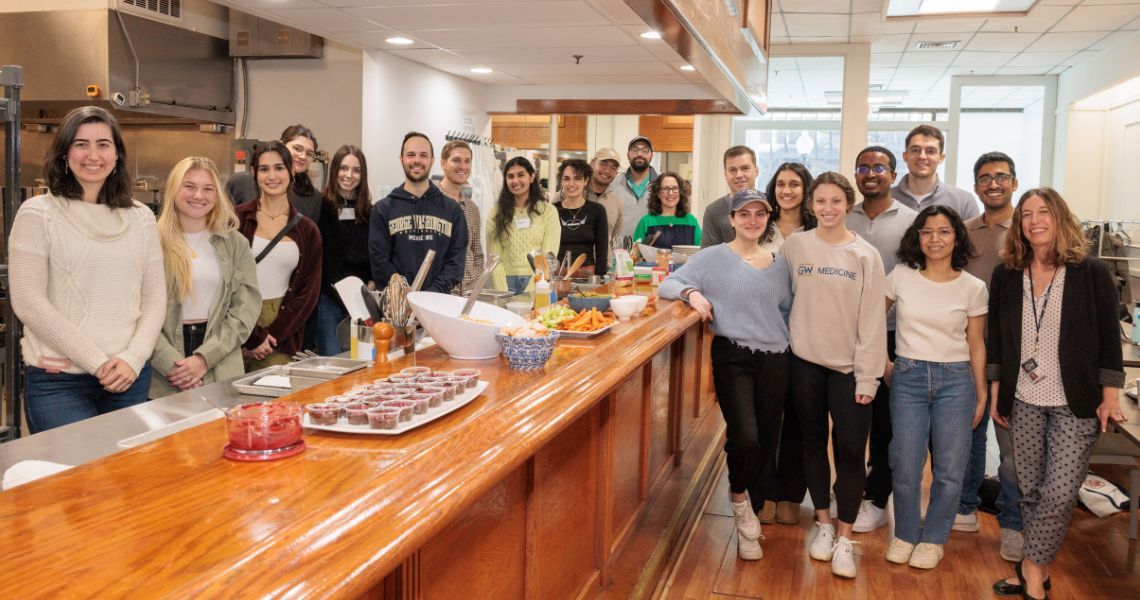
CULI 1810: Fundamentals of Culinary Medicine (4 credits) - Students learn practical skills to apply nutrition concepts to impact their own lives and those around them through culinary medicine principles. Includes hands-on cooking classes, lectures, and guest speakers.
CULI 2810: Topics in Culinary Medicine (3 credits) - Expanding on topics covered in CULI 1810, delves deeper into food-health connections. Students apply nutrition principles in the DC, Maryland, and Virginia area with cooking classes, teaching, research, and nonprofit collaboration. Prerequisites: CULI 1810.
Medical Student Programming:
IDIS 307: Culinary Medicine Elective (open to 3rd and 4th year medical students) -offered twice a year in 2-week blocks. Students learn the foundations of culinary medicine and the fundamentals of healthy eating for the prevention and treatment of disease. This hybrid class combines in person didactic teaching with asynchronous learning utilizing the Health Meets Food Culinary Medicine curriculum paired with hands-on cooking in our professional teaching kitchen.
IDIS 407: Advanced Culinary Medicine Elective (open to 4th year medical students) - this 4 week elective is offered for 9 months of the year and provides a more in-depth experience within culinary medicine. This utilizes the same asynchronous learning curriculum as our IDIS 307 course, but students will participate in departmental research, teaching, and recipe preparation for a more hands on experience in how clinicians can utilize culinary medicine throughout their career.
Community Classes:
The Culinary Medicine Program offers free hands-on cooking classes, open to the public, and geared towards all community members. In these courses, participants will learn to cook healthy, delicious recipes and learn basic nutrition concepts such as building a healthy meal, eating on a budget, meal planning, and how to use leftovers. The concepts are based on Mediterranean Diet principles. Class members prepare and eat different recipes each week and learn how to make terrific, delicious food that just happens to be good for you!
When possible, we offer both in-person and virtual classes. The schedule varies based on instructor availability. Please visit the website here and fill out the form if you are interested in taking Community Classes. We will contact you via email when the next available clases are ready for registration.
If you are a medical professional interested in applying these principles to your patient care, please see more tailored offerings at this link for CME opportunities in partnership with the American College of Culinary Medicine: https://culinarymedicine.org/continuing-medical-education-culinary-medicine/
Other ways to get involved:
Students are also able to participate in the Culinary Medicine Program throughout medical school through participation in events or meetings with the Culinary Medicine Interest Group. Students are able to volunteer to support theSeva Teaching Kitchen community classes andundergraduate classes. The teaching kitchen also provides a space for faculty and students to participate in research and advocacy opportunitiesIf you have additional questions about the Seva Teaching Kitchen or other opportunities to get involved please contact Maya Fiellin at mfiellin [at] gwu [dot] edu (mfiellin[at]gwu[dot]edu)
Culinary Medicine Program Staff:
Medical Director: Alicia Tucker, MD, FAAP, DiplABOM
Alicia Tucker, MD works clinically in child and adolescent obesity medicine with the Children’s National IDEAL Clinic, a multidisciplinary weight management program providing medical and surgical treatment for patients with clinical obesity and cardio-metabolic comorbidities. For over a decade Dr. Tucker has used this expertise to work with students, medical residents, and clinical faculty to support education around pediatric obesity and diet-related chronic disease. Her broader advocacy work centers around how social determinants of health and nutrition insecurity impacts the health of all family members across the lifespan. She explores how novel Food is Medicine initiatives can transform patient’s health and the future of healthcare. Within the GWU Seva Teaching Kitchen and Culinary Medicine Program she works to tailor applicable clinical nutrition education to an even wider spectrum of learners – from community members to undergraduate students to health professionals.
Director of Operations: Maya Fiellin, MPH, CCMS
Maya Fiellin is a Public Health Educator based in Washington, DC. Her areas of focus include nutrition education, health equity, and operations management. As a hands-on senior leader, she brings 15 years of experience spanning public health, community outreach, and hospitality management.
Her work bridges public health nutrition and hospitality systems, with expertise in program development, education, and operational leadership across both nonprofit and hospitality settings. She is committed to building accessible, community-centered approaches to nutrition education and health promotion.
Maya has worked across a range of environments, from start-up organizations to established institutions, and is known for being a self-directed leader who supports her teams and the communities she serves through clear communication, structure, and collaboration.
Lead Instructor and Community Program Coordinator: Jennifer Leon, BS, RD, LN, CCMS
Lead Instuctor: Jennifer Leon, BS, RDN, LN, CCMS
Jennifer Leon, BS, RDN, LN, CCMS is the Lead Instructor for the GW University (GW) Culinary Medicine Program. Ms. Leon teaches Medical Students, Residents, Undergraduates, and community members at GW. She also teaches continuing medical education courses to health professionals. Ms. Leon has helped to develop and revise the curriculum for the Undergraduate course, and she manages the community education program.
Prior to this, Ms. Leon was the dietitian at the George Washington University Cancer Center. There, she provided medical nutrition therapy for patients in current treatment and in survivorship. She founded and led the Nutrition Club support group - a monthly meeting open to patients, caregivers, providers, and community members, where nutrition topics were presented and good food was enjoyed. Ms. Leon worked with each patient’s health history and current environment, and worked to use nutrition as prevention, treatment, and support.
Ms. Leon earned a Bachelor of Science degrees from Indiana University, Bloomington and the University of the District of Columbia. She completed a dietetic internship through Virginia Tech’s Northern Virginia Campus.
Before becoming a dietitian, Ms. Leon was a management consultant, focusing on higher education institutions and government organizations. She brings years of professionalism and attention to detail, along with a passion for healthful living, to the Culinary Medicine program at GW.
Kitchen Manager: Genesis Villareal
Genesis Villarreal is the Kitchen Manager for the Culinary Medicine Program at George Washington University. She holds dual bachelor's degrees in Sociology and Political Science from Florida State University. Upon completion of her undergraduate studies, Villarreal pursued her passion for culinary arts, gaining experience in Michelin-starred restaurants in Washington, DC, where she progressed from prep cook to line cook. Now, at the SEVA Teaching Kitchen, Villarreal combines her culinary expertise with a focus on kitchen management and sanitation standards, while also mentoring students in efficient cooking techniques.
Adjunct Faculty
Timoth Harlan, MD, FACP, CCMS
"Eating well and eating healthy is the same thing," says Dr. Tim Harlan, aka Dr. Gourmet, who discovered his love of food long before embarking on a successful career as a physician. By the age of 18, he was managing his first restaurant and had learned cooking techniques from some of the finest chefs. He subsequently opened an intimate French bistro at age 22.
Returning to school to pursue a degree in Hotel and Restaurant Management, Dr. Harlan found his way to medicine. While completing his degree at Emory University School of Medicine, he began writing about the clear link between food and health, blending his extensive knowledge of food and nutrition with his medical expertise. He previously served as the executive director of the Goldring Center for Culinary Medicine at Tulane and established the GWU Culinary Medicine Program in 2019. He continues to lend his expertise to the program as adjunct faculty.
Student Feedback
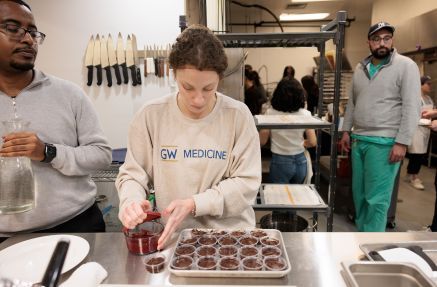
"By working with professionals from multiple different disciplines, including registered dietitians, physicians, executive chefs and social workers, we were able to capture different perspectives that helped paint a complete picture detailing the multitude of factors that relate to making healthy nutritional decisions." – 4th year medical student, IDIS 307 “This course was one of my favorites of medical school. The didactics brought in basic science and clinical concepts and connected them to what we were focusing on that day. I learned how to improve cooking for myself and my family but also how to better counsel patients. It was an insanely helpful and fun rotation!” – 4th year medical student, IDIS 307 “The lab component of this course is a truly great experience, it puts the lecture content into a tangible application which helps in understanding the reasoning behind some of the concepts presented, and it's a fun learning experience overall. It is hands on and can be directly applied to our own daily lives, as well as future clients/patients if applicable.” – undergraduate student, CULI 1810 “Getting to develop our own recipes was really exciting and taught us a lot. Manipulating them to change flavors, calculating nutrition facts, practicing new techniques, it was all really helpful to developing our own future recipes” – undergraduate student, CULI 1810
|
Culinary Medicine in the News

How culinary medicine fights diseases through better food
PBS News Hour
Emerging field of culinary medicine helps fight diseases through better food.

How Culinary Medicine Could Transform Healthcare: Q&A with Dr. Timothy Harlan on Bringing the Kitchen into Medical Education
FoodTank: a think tank for food

Seva Teaching Kitchen Fund Expands GW’s Culinary Medicine Program
GW Medicine + Health Magazine
