
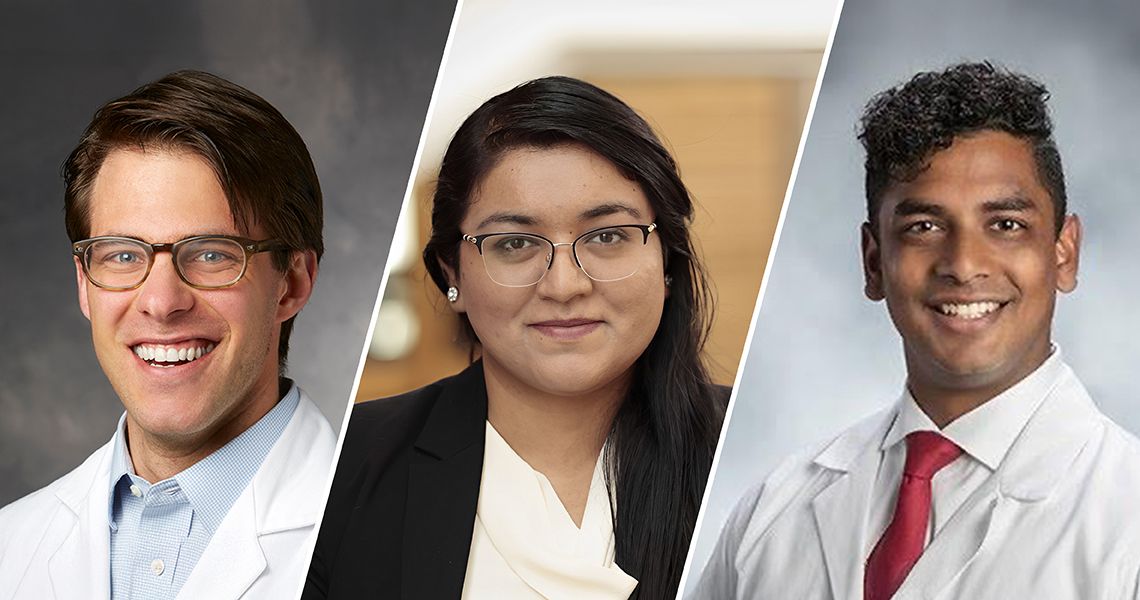
Three George Washington University School of Medicine and Health Sciences residents presented findings from their inaugural Global Clinical Care Alliance (GCCA) Global Health Legacy Fellowships, sharing year-long projects on emergency care in Uganda, glaucoma treatment in India and neural tube defect prevention in Tanzania. Together, the projects demonstrate how sustainable partnerships, local capacity building and practical innovations can improve health outcomes in resource-limited settings. The fellowships, administered through the GCCA and supported by GW alumni, seek to help early-career physicians launch their own global health research while advancing the university’s larger commitment to closing health gaps worldwide.
“The multi-focal approach using distance education with technology and in-person visits creates a longitudinal approach, but also a sustainability aspect, which is super important and fits within the goal of the Health Legacy Fellowship,” said Kate Douglass, MD, MPH, professor of emergency medicine and of global health, and co-chair of the GCCA.
Inaugural fellows Jerry Oommen, DO; Rizul Naithani, DO, MPH; and Timothy Singer, MD, received funding and administrative support to carry out projects designed to strengthen local capacity, support early-career physician researchers and build lasting partnerships in areas of tremendous need.
“One of the beauties of the Health Legacy Fellowship,” said Gail Rosseau, MD ’85, FACS, clinical professor of neurosurgery and co-chair of the GCCA, “is that awardees have faculty mentors both at GW and at their project sites. It was designed specifically with sustainability in mind.”
Expanding the reach of emergency medicine.
Oommen, an emergency medicine physician, explored a shortage of emergency medicine training through his project, “Scaling Up Emergency Resuscitation in Uganda: Simulation, POCUS, and Team-Based Training for ReACT Teams.” For him, sustainability means expanding access to emergency care training beyond Uganda’s largest cities and into the smaller hospitals where the need is great.
Working with Uganda’s Ministry of Health and local partners, Oommen focused on teaching point-of-care ultrasound (POCUS), running simulation, and leading team-based education at three Resuscitation Action Team (ReACT) sites in Mbarara, Katakwi and Yumbe.
“There’s a need for a variety of health care providers from all skill levels to be trained in the most basic emergency care skills to be able to respond more promptly to seriously injured or critically ill patients to improve health outcomes,” said Oommen.
The team paired portable, pocket-sized medical ultrasound devices with a rapid-response training curriculum, giving clinicians in smaller hospitals greater diagnostic heft where X-ray machines, CT scanners, and radiology staff may not be available. Following in-person training, the team met monthly through video calls, enabling clinicians to discuss cases and upload scans for review and consultation.
One such case involved a patient in Yumbe with abdominal pain and missed menstrual periods. Using the handheld ultrasound, local physicians identified internal bleeding from a ruptured ectopic pregnancy, something previous visits had missed, and rushed the patient into emergency surgery.
Local providers “were able to identify that there was bleeding in the abdomen ... and were able ultimately to save a life,” he said, in a remote setting where the patient “otherwise might not have gone to the OR” without the ultrasound findings.
Is the best treatment the one patients can access?
Naithani's project examined another question of access: whether newer glaucoma procedures can improve patients’ quality of life while expanding treatment options in Southern India. Her study, “A Comparative Evaluation of Patient-Reported Quality of Life Using the Indian Visual Function Questionnaire (IND-VFQ-33) Following Combined Minimally Invasive Glaucoma Surgery (MIGS) or Trabeculectomy with Phacoemulsification in Patients with Primary Open-Angle Glaucoma in Southern India.”
Glaucoma is a leading cause of irreversible blindness, often due to increased pressure inside the eye. It affects the optic nerve, which transmits vision from the retina of the eye to the brain. Because the incurable disease progresses slowly and often lacks noticeable early symptoms, it can go undiagnosed until too late.
“Our study objective,” she explained, “primarily consists of looking at the Indian visual functioning questionnaire and seeing the support and comparing it at different stages of post-op period between those individuals who have a traditional trabeculectomy versus those who got the [MIGS procedure].”
Naithani recruited study patients at Aravind Eye Hospitals in Pondicherry and Tirunelveli. Participants were followed for six months as researchers measure intraocular pressure, medication use, visual field testing, optic nerve imaging and patient-reported quality of life, including daily activities, mobility, social interaction and mental health.
The study also examined how access shapes treatment options. Newer technologies and surgical methods include minimally invasive glaucoma surgeries (MIGS) that are not yet widely available in rural India. Often, she said, “with MIGS, you have faster recovery, lower complication rates, reduced post-operative medication burdens.”
At Aravind, patients who cannot pay are generally offered trabeculectomy. Although trabeculectomy remains the standard operation, it requires more intensive follow-up and carries a higher risk of infection.
By comparing clinical outcomes alongside patients’ own experiences, Naithani hopes to produce evidence that can help guide surgical decision-making and expand access to effective glaucoma care.
Establishing the link between climate and neurodevelopmental disorders.
Singer discussed his project, “Neural Tube Defects in a Changing Climate: Systems, Surgery, and Preparedness in Tanzania,” exploring whether rising temperatures during early pregnancy contribute to neural tube defects such as hydrocephalus and spina bifida in Tanzania. Research has shown that exposure to elevated temperatures during the fourth week of gestation, when the neural tube forms, even for a relatively short period of time, is associated with increased risk of neural tube defects.
“The whole purpose,” he explained, “is to provide a more robust estimate of disease burden so interventions can be targeted accordingly.”
Building on that evidence, Singer’s team is combining climate projections with birth registry, climate data, and gestational age data to estimate the current and future burden of spina bifida across Tanzania. Early mapping suggests that north-central regions with the fewest resources may also have the highest burden of disease.
The next phase will establish a national spina bifida registry in partnership with the Muhimbili Orthopaedic Institute, linking registry data with climate information. Ethics approval is underway with support from the fellowship.
Reflecting on the fellowship’s role in launching early-career investigators, Singer said, “This grant serves a critical role as we figure out how to launch our careers. It allows us to establish baseline data, build relationships and support our colleagues abroad who are invested in serving their own communities.”
To watch the full Fellows presentations, visit the GCCA website.


