
GW Cancer Center
Rohan Fernandes, PhD, assistant professor of medicine at the GW School of Medicine and Health Sciences, received more than $700,000 from the Alex’s Lemonade Stand Foundation to research treatment for neuroblastoma.
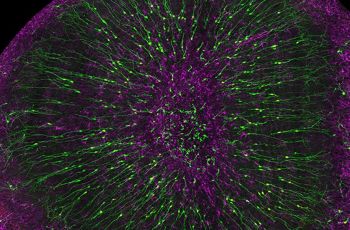
Looking at a winning submission for the first-ever SMHS Art of Science Contest, one might not know the bright purple and green colors represent olfactory bulb interneurons and astrocytes in the brain; but that’s the beauty of art: there’s more to it than meets the eye.
The George Washington University School of Medicine and Health Sciences will participate in the First International Scientific Research Summit of the GW-Spain Consortium in Madrid on Dec. 1–2.
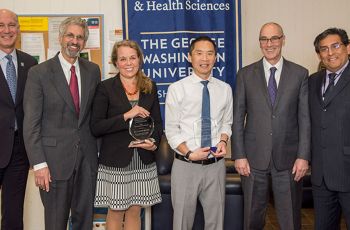
Norman Lee, PhD, and Catherine Bollard, MD, were recognized for their research in cancer at the 2017 Faculty Research Awards.

Robert Siegel, MD '77, was awarded the Distinguished Alumni Achievement Award, the highest honor given to alumni by the university and the GW Alumni Association.
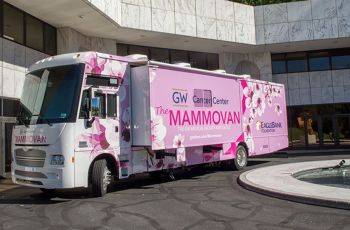
The GW Cancer Center unveiled a new state-of-the-art mobile mammography van, known as the GW Mammovan, to provide breast cancer screening to women in the Washington, D.C. region.

Mitchell R. Smith, MD, PhD, associate center director for clinical investigations at GW Cancer Center and professor of medicine, was interviewed for a segment on Al Jazeera reporting on a new treatment approved for patients with childhood leukemia that uses the patient's own genetically modified…
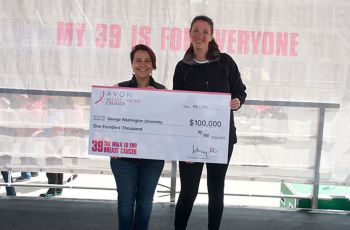
Mandi Pratt-Chapman, MA, associate center director for patient-centered initiatives and health equity at GW Cancer Center, accepted a check from the Avon Foundation at the annual Avon Walk in Washington, D.C. The money will fund a patient navigator who will provide resources to help breast cancer…

A team of researchers at GW Cancer Center found that T-cells lacking in the HDAC11 enzyme performed better in attacking cancer tumor cells. This research highlights the importance of treating HDAC11 as an immunotherapeutic target.
Norman Lee, PhD, professor of pharmacology and physiology, published research in Nature Communications finding that a form of genetic variation, called differential RNA splicing, may have a role in tumor aggressiveness and drug resistance in African American men with prostate cancer.
