
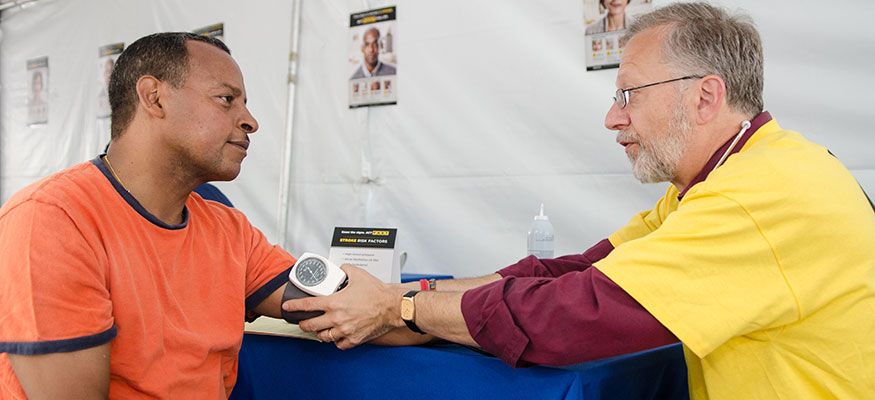
“I didn’t know I had high blood pressure until today,” said lifelong Washington, D.C. resident Angela Sanders. This news was a wake-up call for Sanders. “I would have never known about my increased risk factor for stroke if I didn’t stop for a screening,” she says. Sanders was one of many members of the D.C. community who stopped by the Foggy Bottom metro station for Stroke Screening Day, held on May 30. The annual event, put on by GW’s School of Medicine and Health Sciences (SMHS), the GW Hospital, and the GW Medical Faculty Associates (MFA), is designed to help individuals identify their risk factors for stroke. Sanders’ screening results prompted her to be more proactive about her health. “I’m scheduling a follow-up appointment with my doctor this afternoon,” she adds.
“It’s a great way to give back to the community and educate people about stroke prevention,” says Jeffrey S. Akman, M.D. ’81, RESD ’85, Walter A. Bloedorn Professor of Administrative Medicine, vice president for health affairs and dean of SMHS.
This was third-year medical student Justin Palanci’s first time participating in Stroke Screening Day. “Education is the most important thing for patients,” says Palanci. “I want to help people understand their risk factors so they can make changes in their lives to better their health.”
Getting screened gave Samuel Tesfaeqzi a sense of comfort. “I found out if I follow certain protocols, I will not be a candidate for stroke,” he says. “The screening makes me want to be even more proactive about my health.”
“Today we are reaching out to the community and making sure they know that stroke is preventable,” says Kathleen Burger, D.O., assistant professor of neurology at SMHS, stroke program director at GW Hospital, and director of cerebrovascular neurology at the MFA. Being able to identify the warning signs of a stroke are vital, explains Burger. “Facial drupe, arm weakness, and slurred speech are just some of the warning signs,” she says. Finally, if a person is experiencing these symptoms it’s “time to act and call 911.”
Stroke Program Coordinator at GW Hospital Mary Cres Rodrigazo, R.N., helped to plan the event with Burger and echoed her comments about stroke prevention. “It’s important to know your blood pressure and lead a healthy lifestyle,” says Rodrigazo.
Burger and her fellow GW physicians, nurses, residents, and medical students screened roughly 244 people during the event. The team checked pulse and blood pressure, reviewed the participants’ personal and family medical history, and shared information about how to recognize and respond to stroke.
Clinicians advised participants exhibiting high blood pressure to follow-up with their primary care doctor. Those without doctors were given contact information for the MFA.


