
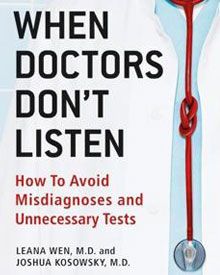
WASHINGTON (July 2, 2014)—When patients go to the doctor, it’s often because they want to find out what’s wrong and how they can get better. However, with a complicated health care system and the time pressure doctors are under, this simple request is rarely met without some complications. “When Doctors Don’t Listen: How to Avoid Misdiagnoses and Unnecessary Testing,” now available in paperback from St. Martin’s Press, was written to help patients better advocate for their health at the doctor’s office.
According to a review in The New York Times: “The book’s insights and cautionary tales should appeal to medical and lay readers alike: they combine into a superb analysis of how doctors listen and think, and offer detailed suggestions for how they could do both better.”
Leana Wen, M.D., director of patient-centered care research and assistant professor of emergency medicine at the George Washington University School of Medicine and Health Sciences, offers eight pillars for patients to ensure their doctors reach the right diagnosis and avoid unnecessary tests:
- Tell your whole story – even if your doctor is steering you away from a narrative and toward the cookbook world of “chief complaints”
- Assert yourself in the doctor’s thought process – find out what your doctor is thinking as he is listening to your history
- Participate in your physical exam – as your doctor is examining you, ask what she is looking for
- Make the differential diagnosis together – keep asking what else could be going on - evaluate with your doctor the likelihood of each possible diagnosis
- Partner for the decision-making process – partner with your doctor to devise a plan for narrowing down possible diagnoses
- Apply tests rationally – do not just consent to tests; ensure that your doctor explains why each test should be done
- Use common sense to confirm the working diagnosis – you should reach at least a working diagnosis at the end of every visit to the doctor – make sure that the diagnosis makes sense
- Integrate diagnosis into the healing process – once a diagnosis is made, ask questions so you understand possible treatments as well as their risks and benefits
“The way medicine is taught and practiced is in need of change,” said Wen. “With ‘When Doctors Don’t Listen,’ I hope to empower patients to improve their medical care and to help lead the way to meaningful, patient-centered health care reform.”


