

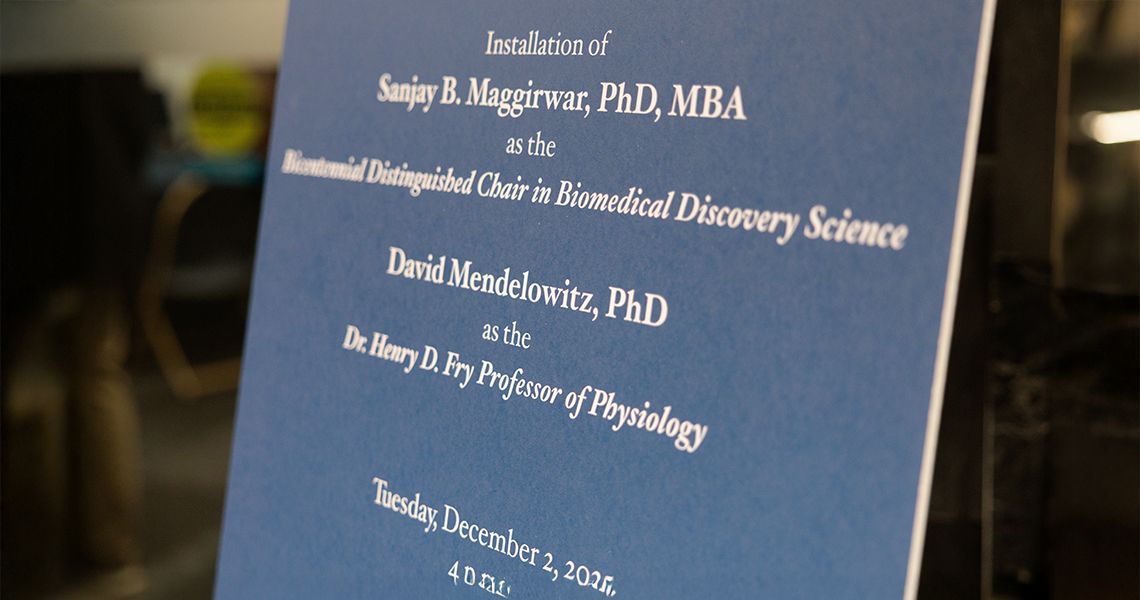



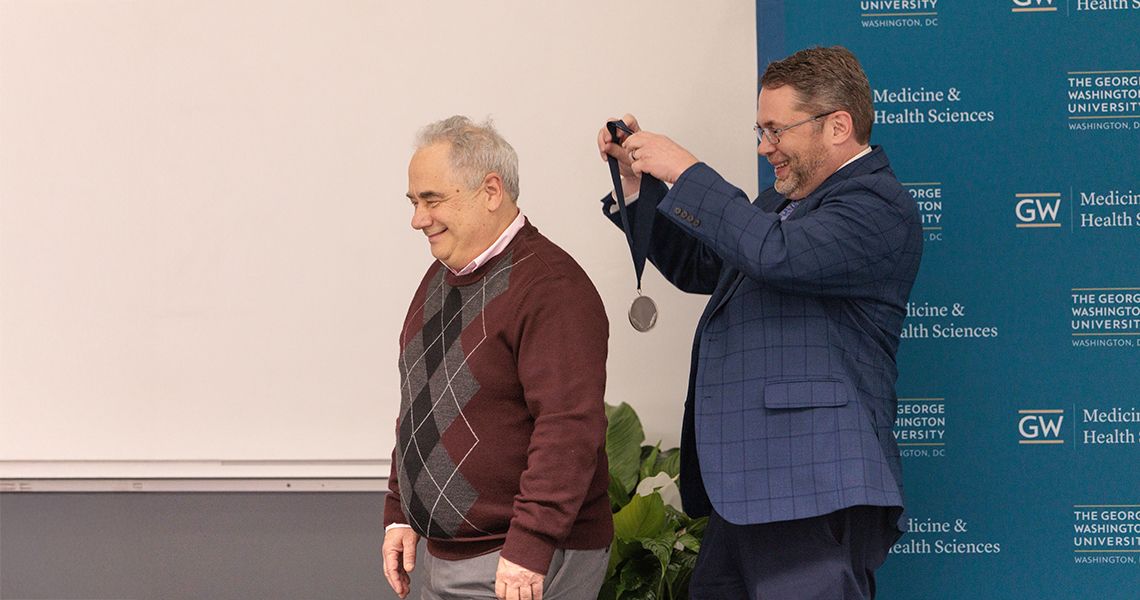


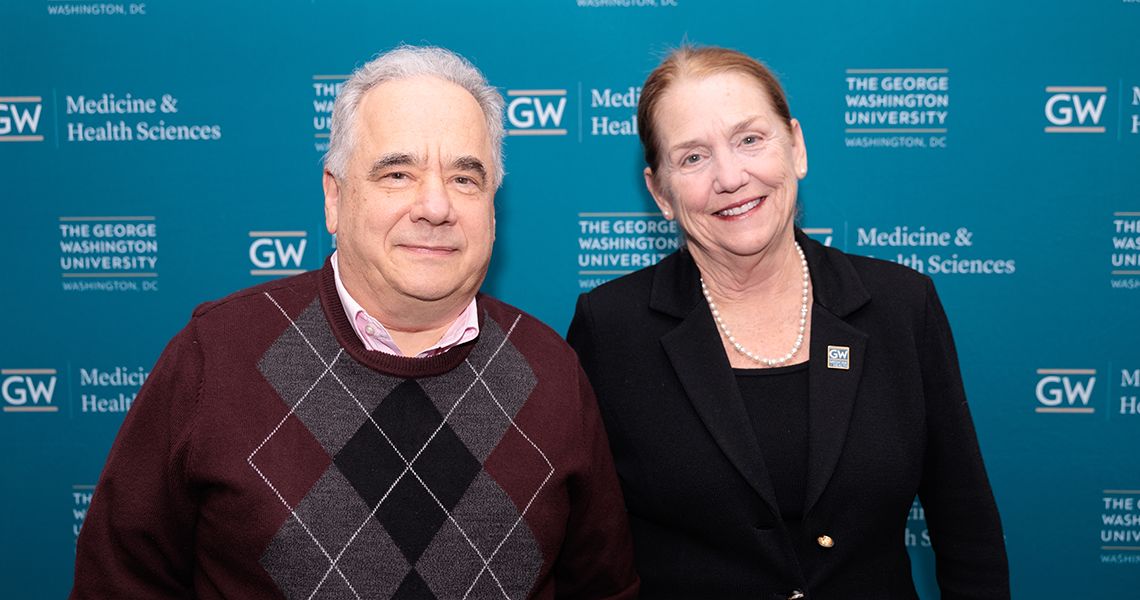


The George Washington University (GW) School of Medicine and Health Sciences (SMHS) celebrated the installation of two prominent department chairs as endowed professors on Dec. 2. Sanjay Maggirwar, PhD, MBA, professor and chair of microbiology, immunology, and tropical medicine (MITM), was installed as the Bicentennial Distinguished Chair in Biomedical Discovery Science. David Mendelowitz, PhD, professor and chair of pharmacology and physiology and professor of anesthesiology and critical care medicine, was installed as the Dr. Henry D. Fry Professor of Physiology.
With their installations, Maggirwar and Mendelowitz joined the elite community of endowed professors, chairs, and directors across GW and SMHS, building upon distinguished careers marked by groundbreaking research, effective mentorship of students and trainees, and strong leadership that has advanced their respective disciplines.
“With each of our vital endowed professorships in the School of Medicine and Health Sciences, we are able to recognize and support the outstanding faculty who propel GW to be an internationally recognized leader in educational excellence, transformative research, and patient-centered care,” said Barbara Lee Bass, MD, FACS, vice president for health affairs, dean of GW SMHS, Walter A. Bloedorn Chair of Administrative Medicine, and professor of surgery.
“Endowed professorships like these,” added John Lach, PhD, interim provost and executive vice president for academic affairs, “are among the highest honor a university can bestow. They serve as powerful catalysts for innovation, discovery, and lasting impact."
Endowments, Lach continued, establish a “permanent foundation of support, empowering scholars to push the boundaries of knowledge, mentor the next generation of leaders, and drive real-world solutions to society’s most urgent challenges.”
Maggirwar studies the neurological and cardiovascular effects of HIV infection. His research investigates how HIV affects the brain and cardiovascular system and identifies mechanisms that link infection to cerebrovascular and cardiovascular disease. He has clarified how platelet and monocyte activation contribute to HIV-associated neurologic disorders. He demonstrated that HIV-infected platelets can transmit the virus to leukocytes and carry these cells into the central nervous system during early infection, helping establish viral reservoirs in the brain.
Since joining GW SMHS in 2019 as professor and chair of MITM, Maggirwar has strengthened the graduate program, launched a National Institutes of Health T32 HIV research initiative, mentored PhD students, and expanded the department’s funded research portfolio.
His professorship is one of the first of 14 positions created through proceeds from the 2022 sale of the university’s partnership interest in GW Hospital. Nine of these positions support SMHS across multiple disciplines and help the school recruit and retain leading faculty, researchers, and clinicians.
“I’m really happy to accept this honor today and I want to do so on behalf of amazing colleagues that I have in MITM, my current and former students, and of course my wife, Asawari,” said Maggirwar. “This moment is not just a personal milestone for me, but it's also a reminder of many wonderful people who have supported me throughout my career.”
“Through this role,” he added, “I commit to upholding GW's values of excellence, integrity and innovation.”
The Dr. Henry D. Fry Professorship in Physiology was established by Annabel Lee Fry in memory of her husband, Dr. Henry Fry, a Washington, D.C., obstetrician who practiced during the late 19th and early 20th centuries. Elected to the American Gynecological Society in 1890, he was noted for his 1889 paper on the application of new forceps as well as a paper on a successful Caesarean section in 1890.
Mendelowitz leads research on neural control of cardio-respiratory function. He investigates non-invasive targets to address obstructive sleep apnea and chronic heart failure. His work on the brainstem and peripheral nervous system led to the discovery of a hypothalamus-to-brainstem pathway that regulates cardio-respiratory activity.
His laboratory has shown that oxytocin, commonly linked to social behavior, regulates respiration and cardiac function. He now leads translational studies testing whether oxytocin can treat sleep apnea, improve cardiac function, and reduce opioid-induced respiratory depression.
In his remarks, Mendelowitz acknowledged his family and colleagues. “Al Scher was my mentor back in Seattle,” recalled Mendelowitz, referring to the late Allen M. Scher, emeritus professor of physiology and biophysics at the University of Washington. “He said, ‘just stick to the science, always just follow the science, no matter what the science said, everything else will fall into place.’”
“We look forward to seeing all they will accomplish in these new roles,” said Lach. “With these appointments, we are not only recognizing the impressive accomplishments of Drs. Maggirwar and Mendelowitz, but we are also reaffirming our university's commitment to advancing medical knowledge and practice as well as improving the well-being of communities here in the district and around the world.”


