
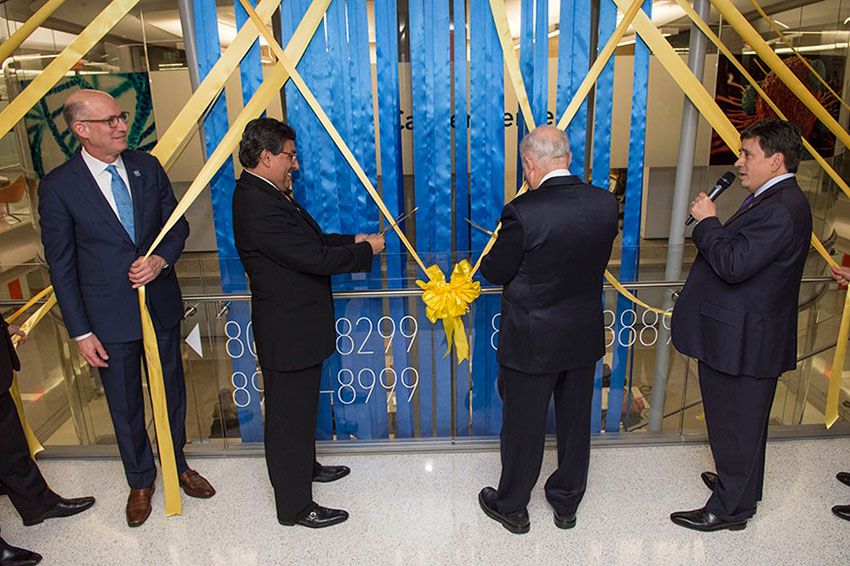
Years of hard work and dedication toward enhancing George Washington University’s (GW) cancer research and care culminated on Dec. 7 at the grand opening of the GW Cancer Center’s (GWCC) new space in the Science and Engineering Hall (SEH).
Just hours after Senate passage of the 21st Century Cures Act, which increases funding for programs including the Precision Medicine Initiative and Vice President Joe Biden’s Cancer Moonshot, the celebration of progress in medical research continued on the SEH’s eighth floor.
“We come together in the heart of the nation’s capital in the spirit of collaboration and with great excitement to launch this center with what we believe is a unique opportunity to advance knowledge in cancer care and treatment through research,” Jeffrey S. Akman, M.D. ’81, RESD ’85, vice president for health affairs at GW, Walter A. Bloedorn Professor of Administrative Medicine, and dean of the GW School of Medicine and Health Sciences (SMHS), said to kick off a round of speeches at the event.
Leaders from throughout GW and the community chatted and laughed with one another in between touring the various research labs and suites dedicated to immunology and immunotherapy, translational science, and microbial oncology.
GWCC only exists because of the coming together of SMHS, GW Hospital, the GW Medical Faculty Associates, and the Milken Institute School of Public Health at GW, said GW President Steven Knapp, Ph.D., who also noted the support given by Children’s National Health System.
“Our aim, above all, is to make sure that we are contributing to battling cancer, a scourge as it remains in our nation and the world. [W]e have the resources, the talent, the strategic focus to make a huge difference,” he said.
One major goal for GWCC is earning a National Cancer Institute (NCI) designation within the decade. “Achieving such a designation would indicate that we have become leaders in basic, translational, clinical, as well as population sciences,” GWCC Director Eduardo Sotomayor, M.D., told the crowd of more than 200.
“Today is the beginning of a challenging but also highly rewarding journey. We are ready to work hard, to be innovative, to be bold,” he said. “I think that we are in a unique position to be a cancer center of the future, a cancer center that is dynamic, flexible. [W]e are truly committed to our vision … to drive innovative research, personalized patient care, and cancer policy in the nation’s capital.”
While GWCC’s work to receive the designation is just beginning, Douglas Lowy, M.D., acting director of the NCI, said he thinks “the center is in excellent hands.”
“The notion of this being support for interdisciplinary research is something that the NCI clearly has been fostering to a great degree,” he said. “In thinking about the opportunities here, I think that they are limitless. You have incredible facilities [and] tremendous dedication.”
Ellen Sigal, Ph.D., chair and founder of Friends of Cancer Research and a member of NCI’s Blue Ribbon Panel supporting Vice President Joe Biden’s Cancer Moonshot, also spoke during the event. “GW Cancer fills a vital, local need. Your efforts will help our neighbors in this community when they need it the most,” she said.
In addition, Washington, D.C. Mayor Muriel Bowser sent a congratulatory note to GWCC that Knapp read at the event. “This facility will help raise awareness, provide research, programs, and services to meet the needs of our underserved communities,” Bowser wrote. “I am pleased that the George Washington University is making significant and visible investment in helping to enhance the quality of life of our citizens.”
As the celebration wound down, leaders from GW and its partners made their way to ribbons of buff and blue draped by the stairwell, scissors in hand. Together, they cut the ribbons. The GW Cancer Center is ready to make its mark on the future.


