
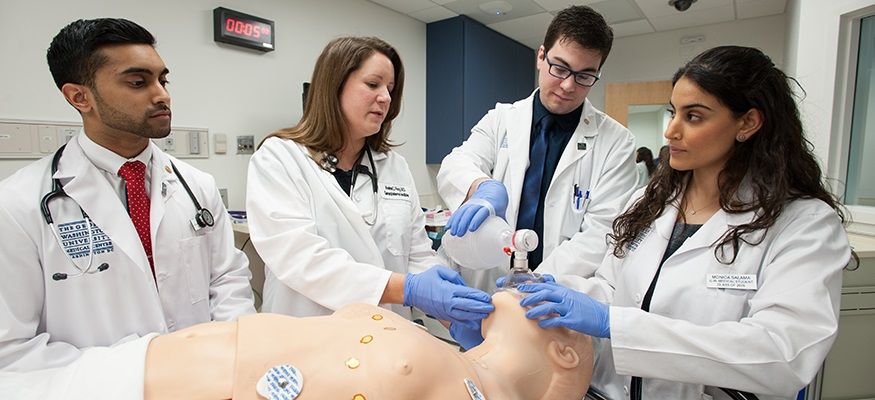
The curriculum leading to the Doctor of Medicine (MD) degree is designed to provide a medical education that prepares graduates comprehensively for residency training, provides them the experience on which to base their career selection, and prepares them for professional lives of continuous learning.
Features of the Curriculum:
- Incorporation of active learning in place of traditional large-class lectures, which provides our students with an earlier clinical experience
- Enhanced professional development of students
- Integration of material to enhance learning and retention
- Added independent study time
- Additional focus on topics such as public health and clinical reasoning
- Each incoming first-year student receives an iPad
- Moving toward a paperless curriculum
- Clinical clerkships begin in the spring of the second year
- Multiple opportunities for students to explore career options in the full spectrum of medical specialties
- Unique only-in-Washington, D.C. educational experiences such as visiting Capitol Hill to learn about health care policy or visiting the United States Holocaust Memorial Museum to learn about medical ethics.
The MD program curriculum has three phases:
- Fundamentals of Medicine
- Fundamentals of Clinical Practice, and
- Transition to Advanced Clinical Practice
1. Fundamentals of Medicine
After an introductory Foundations Course with a focus on core basic science principles and basic clinical skills, the Fundamentals of Medicine phase is organized into organ system-based blocks that occur in the fall and spring semesters of the first year and the fall semester of the second year. Both basic science disciplines (gross and microscopic anatomy, biochemistry/genetics, physiology, pathology, pharmacology, and microbiology) and important theme material (climate change and health, human behavior and development, ethics, diversity and equity, medical humanities) are interwoven throughout each block. For example, instead of a separate, stand-alone anatomy course, anatomy is integrated into the block schedule, with cardiac anatomy taught during the Cardiovascular, Pulmonary, and Renal/Urinary Organ Systems block using a combination of dissection, pro-section, or simulation. Classroom sessions utilize various active learning techniques, and content is often taught in small groups using case-based formats.
The Practice of Medicine course, which focuses on clinical skills and reasoning, is offered in parallel to and integrated with the organ blocks in three longitudinal semester courses across the preclinical curriculum, Practice of Medicine 1, 2, and 3. The Health Systems/Clinical Public Health curriculum is also offered in parallel and consists of three semester-long courses: Patients, Populations, and Systems; Patients in Health Systems; and Applied Population Health. The Practice of Medicine and Health Systems/Clinical Public Health content is linked to organ block topics and themes and integrated when possible.
- Fundamentals of Medicine Blocks and Courses
-
- First-year student orientation
- Foundations of Medicine
- Infection, Inflammation, Immunohematology
- Cardiovascular, Pulmonary, and Renal/Urinary Organ Systems
- Gastrointestinal System and Liver
- Musculoskeletal, Spinal Cord, Rheumatology
- Brain and Behavior
- Reproduction and Endocrinology
- Practice of Medicine 1, 2, and 3
- Health Systems/Clinical Public Health Courses:
- Patients, Populations, and Systems
- Patients in Health Systems
- Applied Population Health
2. Fundamentals of Clinical Practice
The Fundamentals of Clinical Practice phase of the curriculum starts with a two-week Foundations of Clinical Practice course followed by the required clerkships, Intersession, and eight weeks of electives throughout the phase. This phase starts in April of the second year and continues for one year. The Foundations of Clinical Practice course focuses on enhancing clinical reasoning (“Think Like a Doctor”) and procedural skills, such as IV placement and phlebotomy, to prepare students for clinical rotations. The required clerkships, electives, and Intersessions are designed to prepare students for the final year of school and for graduate training in any field of their choice, while providing them with extensive exposure to a variety of fields to enable them to make informed career decisions. Intersessions reinforce basic science, clinical public health, and other important curricular themes and content. There are six different sequences (“cohorts”) for the required clerkships where their order varies, but all students have the same requirements. The required clerkships are Internal Medicine (8 weeks), Pediatrics (8 weeks), Surgery (8 weeks), Psychiatry (6 weeks), Obstetrics/Gynecology (6 weeks), Primary Care (4 weeks), and Longitudinal Primary Care Clerkship (10 half-day sessions over half of the year).
- Fundamentals of Clinical Practice Required Clerkships and Courses
-
- Foundations of Clinical Practice
- Internal Medicine (8 weeks)
- Surgery (8 weeks)
- Pediatrics (8 weeks)
- Obstetrics/Gynecology (6 weeks)
- Primary Care (4 weeks) plus a longitudinal primary care clerkship
- Psychiatry (6 weeks)
- Intersessions
- Electives
3. Transition to Advanced Clinical Practice
The Transition to Advanced Clinical Practice phase begins at the end of April of the third year until graduation. This phase starts with the Intersession IV course and includes 18 weeks of electives plus the required Acting Internship, Emergency Medicine, Neuroscience (in year 3 or 4), Anesthesiology (in year 3 or 4), and a capstone course occurring in the four weeks around match day called Transition to Residency. The Transition to Residency course helps students prepare for internship and includes clinical and procedural preparation and further development as health care professionals with general sessions as well as those within the students’ intended specialty areas. In this curricular phase, students complete a longitudinal scholarly project and a longitudinal clinical public health action plan as part of Intersession IV. Students have unscheduled time for the United States Medical Licensing Examination (USMLE) study and the residency application process.
- Transition to Advanced Clinical Practice Required Activities
-
- Acting Internship
- Emergency Medicine
- Capstone
- Intersession
- Electives
- Neurology (can also be taken in the third year)
- Anesthesiology (can also be taken in the third year)
Curricular Themes
Thematic content comprises content where knowledge and/or skills mastery is vital to the practice of medicine in the 21st century, but this content is not contained in any single scientific discipline or clinical area. Thematic content is longitudinal (vertically integrated) throughout all four years and is integrated into the entire curriculum. An individual theme contains singular or related thematic content where the amount of such content (time in the curriculum, logistical management, scope of content) requires at least one faculty champion (theme director), as determined by the themes committee, to ensure content is appropriately managed in the curriculum and that outcomes are achieved.
Themes Integrated Throughout the MD Curriculum:
- Climate Change and Health
- Ethics and Professional Behavior
- Health Equity, Diversity and Inclusion
- Human Behavior and Development Across the Life Span
- Medical Humanities
Scholarly Concentration Program
The Scholarly Concentration Program is an educational program designed to enrich students’ experiences and opportunities and expose them to various concentrations of study. SMHS believes this program will further students’ medical careers by providing a broader healthcare perspective and exposure to leadership opportunities.
Students can choose a program of study in one of several healthcare areas outside the standard clinical curriculum. The Scholarly Concentration Program’s areas of study are:
- Clinical and Translational Research Track
- Clinical Practice Innovation and Entrepreneurship
- Community/Urban Health
- Disaster Medicine
- Global Health
- Health Policy
- Medical Education and Leadership
- Medical Humanities
While the Scholarly Concentration program is not required, a majority of students participate in this program.
